2026 Cost Guide
How Much Does a Retaining Wall Cost in 2026?
Quick Answer: The average cost of retaining wall in 2026 is $6,500. Typical range: $3,000 – $15,000 ($20 – $60 per sq ft of wall face).
Source: ClearCost Fair Market Rate data — updated April 2026
National Average
$6,500
Typical range: $3,000 – $15,000
$20 – $60 per sq ft of wall face
Get Local EstimateCost at a Glance
Retaining walls hold back soil on sloped properties, prevent erosion, and create usable level areas in your yard. The national average cost is around $6,500 for a typical retaining wall, with most projects falling between $3,000 and $15,000. Costs depend on the wall material, height, length, and whether engineering is required. Walls over 4 feet tall generally require a structural engineer's design and a building permit.
Retaining Wall Cost by Material
Material choice affects both the appearance and structural capability of a retaining wall. Landscape timbers are the cheapest option but have the shortest lifespan and are limited to walls under 3 feet. Concrete blocks (interlocking segmental units) are the most popular choice due to their strength, variety of finishes, and moderate cost. Natural stone walls provide a premium aesthetic but are more labor-intensive to build. Poured concrete walls are the strongest option and are often used for tall engineered walls and foundations.
Cost per Square Foot of Wall Face
Cost by Wall Height
Wall height dramatically affects cost because taller walls require deeper foundations, more material, reinforcement, and often engineering approval. Walls under 3 feet are relatively simple gravity walls that rely on their own mass to resist soil pressure. Walls 3–4 feet typically need geogrids or reinforcement layers behind the wall. Walls over 4 feet almost always require a structural engineer's design, a building permit, and specialized construction techniques including a reinforced footing and drainage system.
Cost by Wall Height (Concrete Block, per linear foot)
Want pricing specific to your zip code?
Our Fair Market Rate™ factors in local labor rates and material costs.
Drainage, Engineering & Permits
Proper drainage is the single most important factor in retaining wall longevity. Water pressure behind the wall (hydrostatic pressure) is the leading cause of retaining wall failure. Every retaining wall should include a drainage aggregate layer behind the wall, a perforated drain pipe at the base, and filter fabric to prevent soil from clogging the drainage system. Walls over 4 feet tall typically require an engineer's stamp, which adds $500–$1,500 to the project but ensures the wall is designed to handle the actual soil loads.
Drainage & Engineering Costs
Labor Costs
$10 – $25 per sq ft of wall face
Retaining wall labor includes excavation, compacting the base, laying courses of block or stone, backfilling with drainage aggregate, installing drain pipe and filter fabric, and compacting backfill in lifts. A professional crew of 2–4 workers can typically build 20–40 square feet of wall face per day depending on material and height. Labor accounts for roughly 50–60% of the total project cost. Tall walls that require geogrids and engineered footings take significantly longer per linear foot.
Enhancement & Improvement Costs
What Drives the Cost
- Wall height — costs increase exponentially as height grows due to engineering and reinforcement needs
- Material choice — timber is cheapest; natural stone and engineered concrete are most expensive
- Wall length — longer walls benefit from economies of scale in mobilization and base prep
- Soil conditions — clay, sandy, or wet soil may require additional drainage and engineering
- Access — limited equipment access to the site increases labor time for material transport
Pro Tips
- Always include proper drainage behind the wall — it is the single most important factor for longevity
- Hire a structural engineer for any wall over 4 feet — it protects your investment and may be required by code
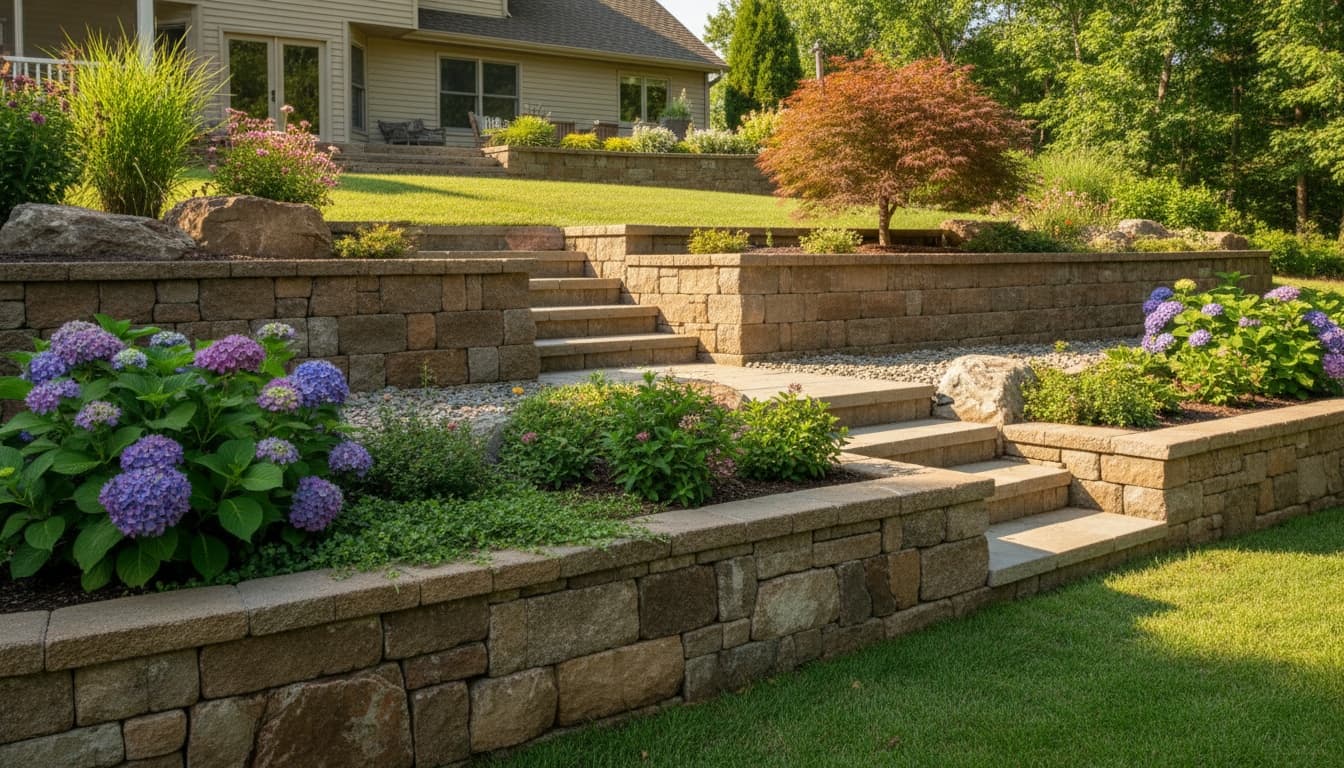
- Consider terraced walls (two shorter walls) instead of one tall wall to reduce engineering costs
- Compact the gravel base thoroughly before laying the first course — a level base prevents future problems
A typical retaining wall of 50–100 linear feet takes 3–7 days to build.
Frequently Asked Questions
Do I need a permit for a retaining wall?
Most jurisdictions require a permit for retaining walls over 4 feet tall (measured from the bottom of the footing to the top of the wall). Some areas set the threshold at 3 feet. Walls that support structures, hold back a slope above a building, or affect drainage patterns may require permits regardless of height. Always check with your local building department.
How long does a retaining wall last?
A properly built concrete block retaining wall with adequate drainage lasts 50–100 years. Natural stone walls can last even longer. Timber retaining walls have a shorter lifespan of 15–25 years before the wood deteriorates. The most common cause of premature failure is inadequate drainage, which allows water pressure to build behind the wall.
Can I build a retaining wall myself?
Short retaining walls under 3 feet are a manageable DIY project using interlocking concrete blocks, which require no mortar. However, walls over 3 feet involve significant excavation, engineering considerations, and proper drainage installation that are best handled by professionals. An improperly built retaining wall can fail catastrophically, causing property damage and safety hazards.
Why do retaining walls fail?
The most common causes of retaining wall failure are inadequate drainage (allowing water pressure to build behind the wall), insufficient footing depth, lack of geogrid reinforcement in taller walls, and poor compaction of the base material. Frost heave in cold climates can also damage walls that are not built on footings below the frost line.
These are national averages. Get a price for your zip code.
Our Fair Market Rate™ factors in local labor rates, material suppliers, and market demand.
Retaining Wall Cost by City
Local estimates adjusted for regional labor and material costs.
New York, NY
$3,375 – $16,900
Los Angeles, CA
$3,400 – $17,050
Chicago, IL
$3,100 – $15,550
Dallas, TX
$3,100 – $15,475
Houston, TX
$2,950 – $14,800
Atlanta, GA
$3,000 – $15,025
Washington, DC
$3,500 – $17,475
Philadelphia, PA
$3,100 – $15,525
Miami, FL
$3,425 – $17,125
Phoenix, AZ
$3,050 – $15,225
Boston, MA
$3,300 – $16,450
Riverside, CA
$3,150 – $15,725