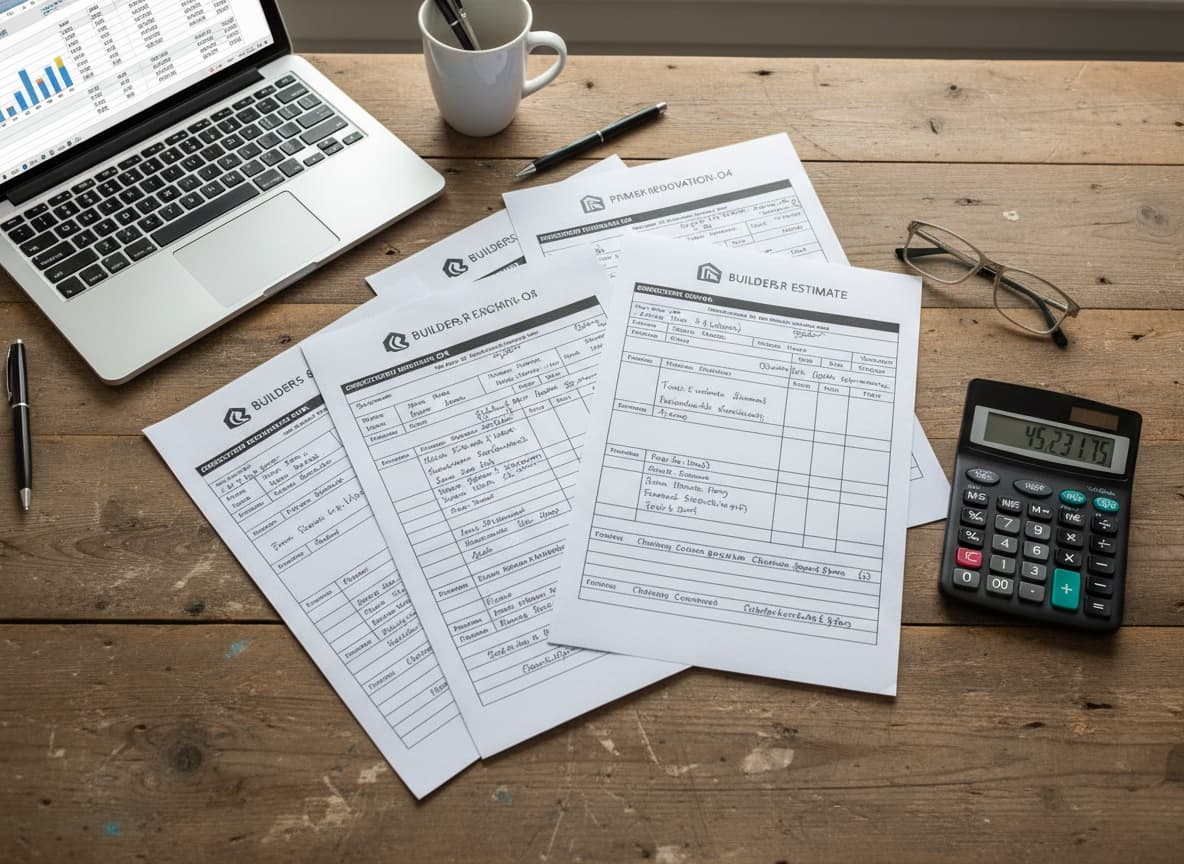
Conventional wisdom says: "Get at least three quotes." And that's not wrong — you should understand the market. But the way most homeowners collect quotes actually works against them.

The Problem with Multiple Quotes
Time cost: Scheduling 3–5 site visits, taking time off work, and explaining your project repeatedly eats 10–20 hours of your life. For dual-income families, this often means burning PTO or squeezing visits into already-packed weekends.
Apples-to-oranges: Without a standardized scope, each contractor bids on a slightly different project. Comparing quotes becomes meaningless. One contractor includes demo in their bid; another lists it as a separate line. One includes a dumpster; another doesn't. By the time you normalize all the variables, you've spent more time analyzing quotes than you'll save by choosing the cheapest one.
Race to the bottom: Contractors who know they're competing against 4 others often underbid to win — then make up the margin in change orders. This is the most insidious problem: the lowest bid is frequently the most expensive project when all is said and done.
The Psychology of Cheap Bids
There's a well-documented pattern in construction called "buy-in pricing." The contractor deliberately prices below cost to win the contract, knowing they'll make their margin through change orders, material substitutions, and corner-cutting.
Why does this work? Because homeowners anchor on the lowest number. When you see bids of $18,000, $22,000, and $25,000, the $18,000 feels like a deal. But the $22,000 and $25,000 contractors may have been more thorough in their scope — accounting for items the $18,000 bid conveniently omitted.
What Smart Homeowners Do Instead
The most informed homeowners we work with follow this process:
Step 1: Get a data-backed Fair Market Price for their project (this is what ClearCost provides). This gives you an objective benchmark based on your specific project details and local market data.
Step 2: Use that price as a benchmark when evaluating contractors. If your Fair Market Price is $22,000, a $15,000 bid should raise questions (what are they leaving out?) and a $30,000 bid should require justification (what premium are they offering?).
Step 3: Choose based on trust, communication, and track record — not just the lowest number. The best predictor of a successful project isn't the cheapest price — it's the quality of communication during the sales process. A contractor who's responsive, detailed, and transparent before they have your money will almost certainly be the same after.
One Quote Is Enough — If It's the Right One
Here's a counterintuitive truth: homeowners who get one quote from a vetted, well-matched contractor often have better outcomes than those who collect five quotes from strangers on the internet. The key isn't the number of quotes — it's the quality of the match and the transparency of the pricing.